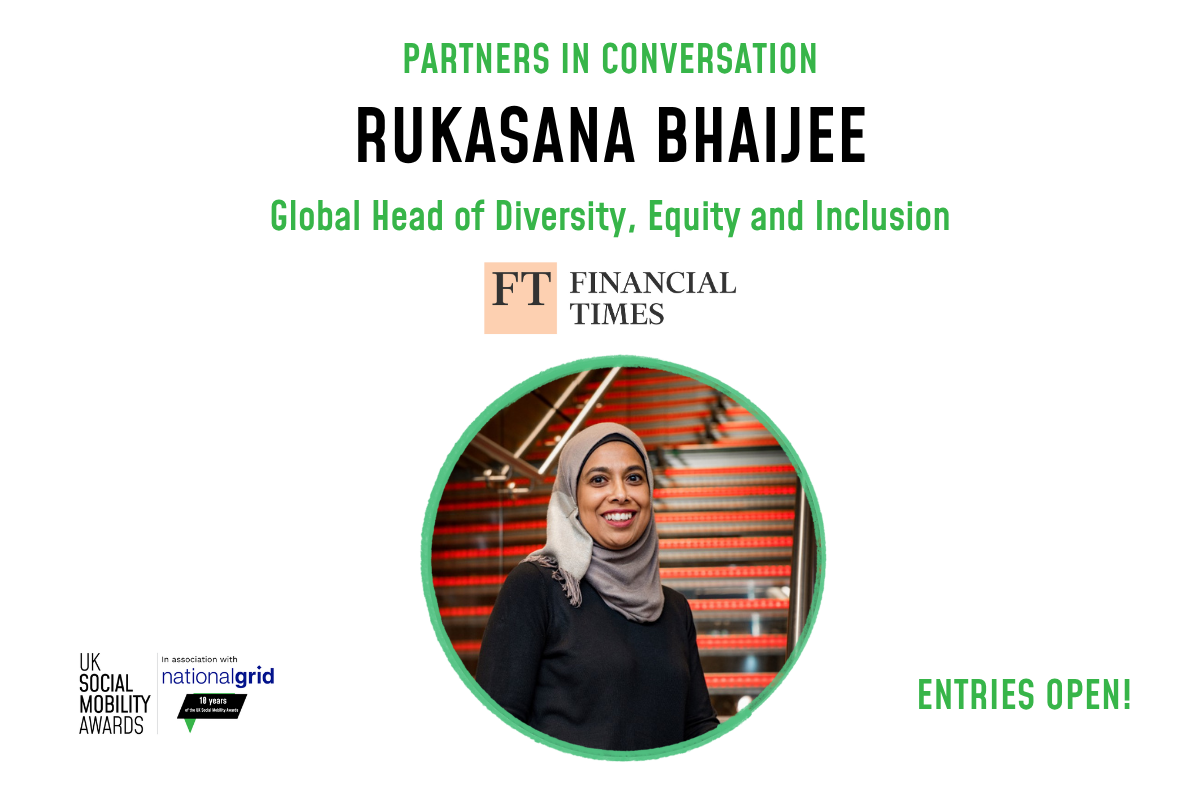
This year, we are delighted to welcome the Financial Times as a new media partner for the UK Social Mobility Awards (SOMOs) – a partnership that feels both timely and deeply aligned.
As the UK’s leading national awards dedicated to recognising and celebrating social mobility excellence, the SOMOs have become a trusted authority across sectors. Each year, they attract entries from major employers, SMEs, charities, public bodies, and innovators committed to widening opportunity. Their reputation, reach, and cross-industry influence make them a powerful platform for organisations driving meaningful change.
We were joined by the FT’s Global Head of Diversity, Equity and Inclusion, Rukasana Bhaijee, to discuss what the Financial Times is doing to address social mobility.
The FT’s reporting has consistently explored the realities of inequality, the barriers facing young people from less-advantaged socio-economic backgrounds, and the role employers can play in creating fairer pathways into work. Whether through data-driven analysis, features on opportunity and education, or coverage of workplace trends, the FT has helped keep social mobility firmly on the national agenda.
Our Q&A with Rukasana Bhaijee
What motivated the FT to become a media partner for the UK Social Mobility Awards?
“We are committed to diversifying the future of our sector and have been taking steps to open access to our industry. We know that the power of the FT as a media partner to the SOMOs means we can use our brand as a force for good; we can create a wider societal impact beyond our own organisation.”
“The SOMOs are the leading national platform recognising organisations that are genuinely moving the dial on social mobility. Their cross-sector reach, credibility, and influence make them a powerful force for change. As an employer, we believe widening access to opportunity is essential for a fair and future-focused economy. Partnering with the SOMOs allows us to champion that mission more visibly, amplify the stories of organisations driving progress, and play our part in accelerating change across the UK.”
“Many of our colleagues are keen to get involved in mentoring young people through our flagship programmes, like News School, School of Journalism, work experiences, and insight days. Colleagues care deeply about this topic and are pleased to see us doing more to address the gaps we know exist.”
Why should organisations enter the UK Social Mobility Awards?
“Entering the SOMOs provides organisations with an opportunity to pause and reflect on what they’re doing and consider if they’re taking the right actions. Could they be doing something differently?”
“It’s also an opportunity to signal to future talent that their organisation welcomes all talent and that they are striving to be better, to do better.”
“Entering the SOMOs allows you to tap into their wider network, learn what other people are doing, meet other organisations, and hear their stories and social mobility journeys.”
How do you think public perception can change when organisations proudly take part in the UK Social Mobility Awards and spread the word?
“It’s really important to be visible, because there are still so many misconceptions. This is about understanding that organisations benefit from having talented people from across society. ”
“By being visible and open, you can help existing talent within your organisation feel that they belong, building trust and psychological safety. You can also support progression by addressing barriers such as accent bias, imposter syndrome, communication confidence, and unwritten workplace norms.”
What are your thoughts on the current state of social mobility in the UK? What changes would you like to see?
“The UK has made progress over the past decade, and organisations across sectors are taking more targeted action to improve access. What I would like to see now is a greater focus on progression. Are people from different backgrounds having the same experience once they join an organisation? Do organisations have the right data? And, in the age of generative AI, are the questions we were asking 10 years ago still the right ones? Maintaining momentum will require organisations across the UK to keep challenging their assumptions and adapting their approach.
What else is the FT doing to support social mobility?
“In 2025, the FT partnered with more than 46 organisations championing social mobility. We engaged with over 2,300 people and reached a further 7,000 through online workshops. We also offered 18 centralised work experience placements and eight News School summer internships.”
Our flagship News School programme gives young people from lower socioeconomic backgrounds an introduction to careers across journalism, sales, advertising, product, technology and HR through a two-week evening course. Participants are then matched with mentors for six months, gain access to work experience, and can apply for summer internships.
In 2025–26, we are piloting the School of Journalism programme in partnership with the NCTJ, giving aspiring journalists the chance to gain a foundation journalism qualification.
Through FT Schools, young people can access the FT on their phones. The Financial Literacy and Inclusion Campaign (FLIC), a charity established by the FT, equips them with the knowledge and tools to build their financial literacy.
And we want to do more. We still have much to learn, which is why we are proud to support The SOMOs as a media partner.
A landmark year, and a moment to step forward
2026 marks a significant chapter for the UK Social Mobility Awards. As the UK’s leading cross-sector awards for social mobility, the SOMOs invite organisations to reflect on the progress they’ve made – and the progress still to come.
If your organisation is:
- Widening access
- Breaking down structural barriers
- Opening doors for underrepresented talent
- Investing in long-term opportunity creation
…then this is your moment to step forward and be recognised.
Entries are open now and close on 26 June, with winners announced on 6 October at the annual Awards ceremony.
Be part of the story
Social mobility doesn’t happen by accident. It happens because organisations choose to act – to challenge old systems, to champion new pathways, and to believe in the potential of people who have historically been overlooked.
The SOMOs exist to celebrate that work, to elevate it, and to inspire more of it.
If your organisation is driving change, we want to hear your story. Enter the 2026 UK Social Mobility Awards. Be recognised, be visible, be part of the movement shaping a fairer future.