We are proud to continue our long-standing relationship with Lloyds Banking Group, a committed supporter of the UK Social Mobility Awards and an organisation that shares our belief that talent, ambition and potential exists everywhere. For many years, Lloyds Banking Group has championed social mobility, recognising the importance of creating pathways to opportunity and helping individuals fulfil their potential, regardless of background.
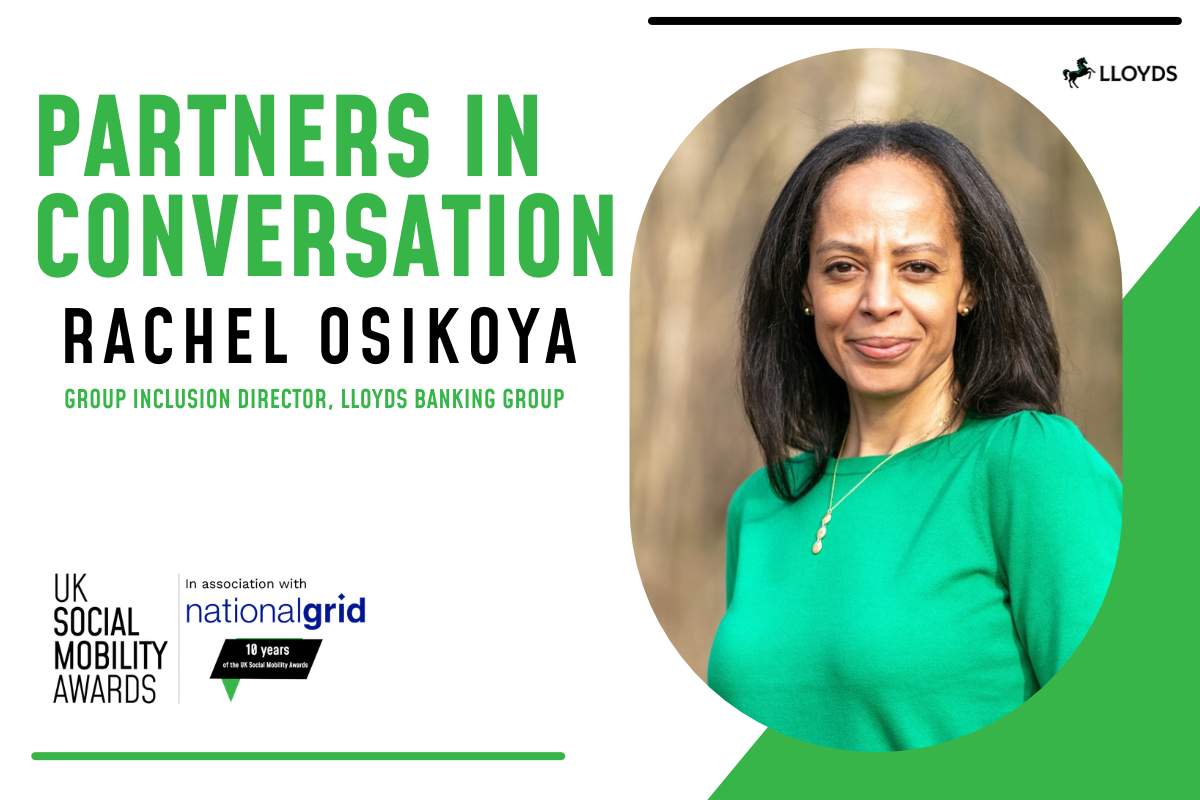
We were joined by Rachel Osikoya, Group Inclusion Director at Lloyds Banking Group, to discuss why social mobility is so important to the organisation and how it is embedded throughout its inclusion strategy.
Guided by its purpose of helping Britain prosper, Lloyds Banking Group views social mobility as both a societal responsibility and a business imperative. From investing in skills and supporting young people to championing colleague engagement through mentoring, volunteering and employee networks, the organisation is working to create more equitable access to opportunity. Through initiatives such as Project Hope and its commitment to supporting young people across the UK, Lloyds Banking Group continues to demonstrate how organisations can help drive lasting change and ensure that background does not determine future success.
How does supporting the UK Social Mobility Awards align with your broader purpose or values?
“At Lloyds Banking Group, our purpose is helping Britain prosper, and social mobility sits at the heart of that ambition. We believe talent, ambition and potential exist in every community, but opportunity is not always distributed equitably. The UK Social Mobility Awards celebrate those changing that reality and creating pathways to success. They remind us of what’s possible when organisations work together to remove barriers.”
What does being part of the SOMOs community mean to your organisation and your people?
“The SOMOs community connects us with organisations that share a commitment to widening opportunity and creating lasting change. It allows us to learn from others, share experiences and contribute to a wider movement focused on social mobility. For our colleagues, it provides a sense of pride and purpose, reinforcing the value of the mentoring, volunteering and outreach they support, showing how individual actions can contribute to broader societal impact across the UK.”
What change would you most like to see across the UK in the next 5–10 years?
“I’d like to see a UK where every young person has equal access to the skills, experiences and opportunities they need to fulfil their potential, regardless of background. Too much talent remains untapped because access to opportunity is unequal. That’s why we’ve committed £100 million in skills investment and supporting more than 600,000 young people by 2030, putting us on track to support 1million young people in a decade. My hope is that background no longer predicts future success, allowing talent and potential to flourish everywhere.”
What role do senior leaders play in driving this agenda forward?
“Senior leaders play a critical role in creating accountability and driving lasting change. At Lloyds Banking Group, two Executive Committee members and 31 Executive Ambassadors actively champion our social mobility agenda, helping embed it into our business strategy, culture and decision-making. Their visible sponsorship helps build understanding, drive action and maintain momentum. Personally, I’ve seen how powerful it can be when leaders share their own stories and advocate for change, helping create an environment where colleagues feel confident engaging, reinforcing that social mobility is a strategic priority for the organisation.”
Can you share a story or example that captures the real-life impact of your work in this space?
“Project Hope demonstrates the power of targeted action. Designed to support care-experienced young people into sustainable employment, it combines meaningful career opportunities with tailored support to build confidence, skills and financial independence. The results have been transformational for participants, but what makes me most proud is its wider impact. By influencing employers, suppliers and partners to create similar opportunities Project Hope is helping drive systemic change, extending its impact far beyond the programme itself.”
Why is it important for organisations to publicly champion social mobility through platforms like the SOMOs?
“Public advocacy matters because visibility drives awareness and change. When organisations openly champion social mobility, they help normalise conversations about background, opportunity and inequality that have historically received less attention than other areas of inclusion. Platforms like SOMOs enable organisations to demonstrate what is possible, challenge outdated assumptions and encourage others to take action. They demonstrate the value of investing in skills and potential and provide important role models for young people who may not see themselves represented in certain industries or professions.”
Celebrating this year’s leaders in social mobility
The UK Social Mobility Awards in association with National Grid shine a spotlight on the employers who are not just talking about social mobility, but transforming it. Explore how employers across the UK are advancing social mobility by discovering this year’s finalists here.